🎯Ace your interviews with GIR Workshop with this is a test text I will make it big in length to test the marquee
🎯Ace your interviews with GIR Workshop with this is a test text I will make it big in length to test the marquee
Article Topics
You're about to interview at Deloitte, PwC, EY, or KPMG. You've polished your resume, practiced your case studies, and researched the firm's values. Then you get an email: before any human speaks to you, an AI will evaluate your English communication skills.
That AI is the Versant test, and most candidates have no idea what it's actually measuring. They assume perfect grammar and impressive vocabulary will carry them through. They're wrong.
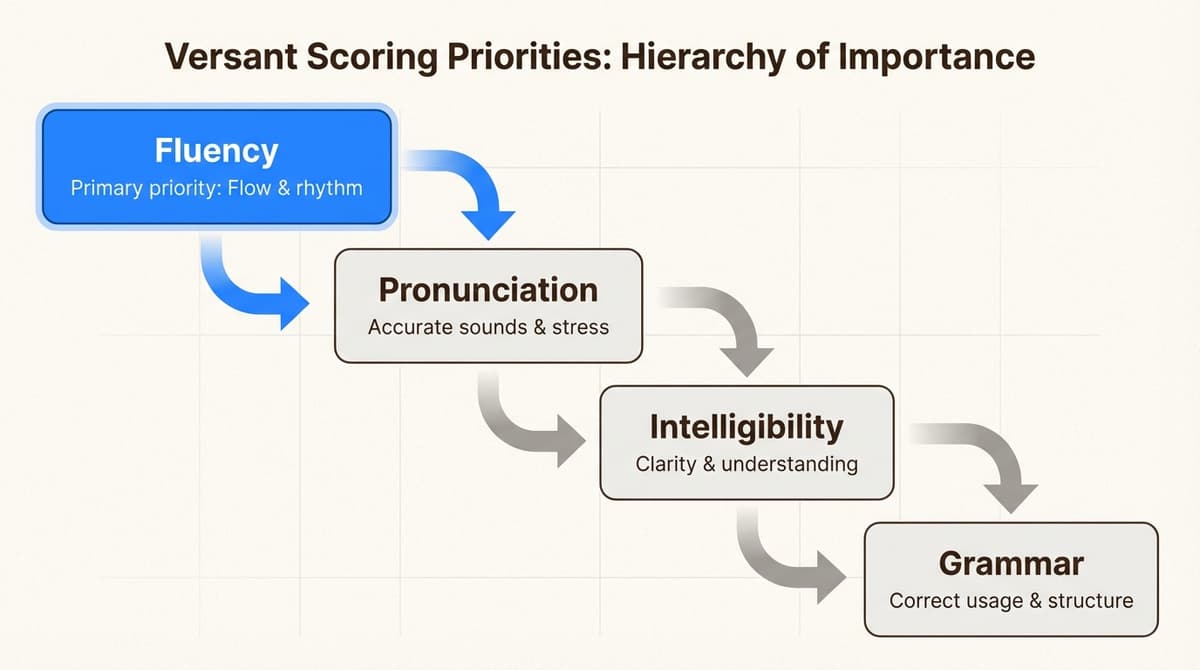
Here's what Big 4 recruiters won't tell you: the Versant algorithm prioritizes fluency and intelligibility over perfect grammar or sophisticated vocabulary. A candidate who speaks naturally with a few minor errors will outscore someone who pauses constantly to construct flawless sentences. Understanding this changes everything about how you should prepare.
This guide breaks down exactly what the AI is listening for, provides section-by-section strategies, and exposes the myths that tank scores. By the end, you'll know how to walk into that test confident.
The Versant test is an AI-powered English assessment created by Pearson with over 25 years of automated language assessment expertise. Unlike traditional tests where a human grades your responses, Versant is 100% AI-scored with results delivered in minutes.
Here's why that matters for Big 4 hiring:
The test measures "facility in a spoken language," which Pearson defines as the ability to understand spoken English on everyday topics and respond appropriately at a native-like conversational pace. It's not testing whether you know what "obfuscate" means. It's testing whether you can communicate clearly and naturally in a professional setting.
Big 4 firms specifically choose Versant because of its efficiency and objectivity:
| Why Big 4 Uses Versant | Impact |
|---|---|
| Time-to-hire reduction | 94% of corporate customers report faster hiring decisions |
| Improved client communication | 64% say candidates hired with Versant communicate better with clients |
| Bias-free screening | AI eliminates human subjectivity in initial evaluation |
| Real-world focus | Tests practical communication, not academic English |
The test Big 4 firms typically use is the English Speaking and Listening Test, which takes approximately 17 minutes. Scores range from 10 (beginner) to 90 (proficient) on Pearson's Global Scale of English. For client-facing roles at Big 4 firms, expect requirements in the 59-75+ range, which corresponds to B2-C1 on the CEFR framework.
Bottom line? These firms care about whether you can communicate clearly with clients and colleagues at a natural pace, not whether you can impress them with advanced vocabulary.
This is the core insight most candidates miss, and understanding it gives you a significant advantage.
The AI evaluates your responses across four dimensions, and the priority order matters:
Notice what's not at the top of that list: grammar and vocabulary. The AI was trained by expert graders to identify the same traits human experts value when assessing language proficiency. And those experts consistently value communication effectiveness over technical perfection.
The algorithm rewards:
The algorithm penalizes:
The fluency hack in practice: Imagine two candidates answering the same question. Candidate A pauses frequently, searching for impressive vocabulary, and corrects themselves twice. Candidate B speaks naturally with a few minor grammatical slips but maintains steady flow. B scores higher because the AI is measuring what expert graders care about: can this person communicate effectively in real professional situations?
Versant tests measure the ability to understand spoken language on everyday topics and respond appropriately at a native-like conversational pace. Native-like pace is the key phrase here.
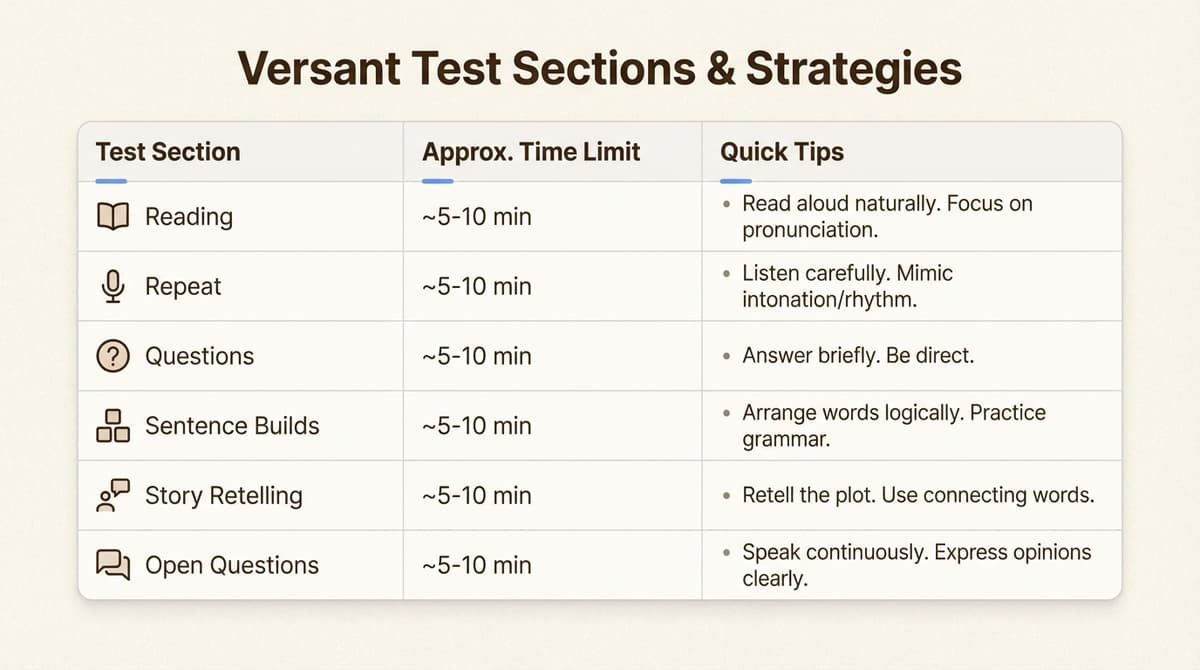
The 17-minute test has 6 sections with 37 total items. Here's how to approach each one strategically.
What it tests: Listening comprehension and concise response formation
Format: 8 questions, 15 seconds each to respond
Hacks:
What it tests: Listening comprehension, verbal memory, and manner of speaking
Format: 16 sentences ranging from 5-15 words, 15 seconds each
This section is heavily weighted because it tests multiple skills simultaneously.
Hacks:
What it tests: Comprehension of natural dialogue
Format: 6 questions about 2-person conversations, 8 seconds to start responding
Hacks:
What it tests: Listening comprehension and memory retention
Format: 2 short stories with 3 questions each, 8 seconds per question
Hacks:
What it tests: Synthesis, spontaneous speaking, and fluency
Format: 2 passages, 30 seconds each to retell
This section reveals your true English fluency because you can't just repeat memorized phrases.
Hacks:
What it tests: Extended speaking, coherent argumentation, fluency
Format: 2 questions, 40 seconds each
Hacks:
Candidates lose sleep over the wrong things. Let's address the three biggest worries directly.
Reality: The algorithm measures intelligibility, not accent.
The test explicitly claims bias-free testing because the AI is trained on diverse speaker patterns from around the world. What matters is whether you can be understood clearly, not whether you sound British, American, or like any specific native speaker.
Your accent is fine. What actually hurts scores:
The fix: Focus on clarity and projection, not changing your accent. Pronounce word endings fully and speak at a volume that's easy to record.
Reality: Grammar is the lowest weighted factor in scoring.
The official guidance mentions "correct grammar" last, after fluency, comprehension, and clear speech. Minor grammatical errors that don't impede understanding barely affect your score.
What actually hurts scores:
The fix: Prioritize natural speech. A sentence like "I think this is a good idea because it help the team" scores better than a halting, "I… believe… that this… would be… beneficial… for… the organization."
Reality: Speaking too slowly hurts your fluency score.
The algorithm expects "native-like conversational pace." Speaking slowly and carefully signals to the AI that you're struggling with the language. It's the opposite of what you want.
What actually works:
The fix: Practice speaking at your normal pace. If anything, err slightly faster rather than slower. Record yourself and compare to how native speakers discuss similar topics.
Technical issues can tank scores regardless of your English ability. Don't let them.
Your physical space matters more than you might think:
Get this right before test day:
The right mindset makes a difference:
The biggest predictor of Versant success is preparation. Candidates who simulate the test environment score significantly better than those who wing it.
Focus on the skills the algorithm actually measures:
One Versant test is typically enough to understand the format and identify your weak areas.
Also read: How to pass Pymetrics games: A complete guide for CAs in 2026
A1: While specific requirements vary by role and firm, Big 4 client-facing positions typically expect scores in the 59-75+ range on the Global Scale of English. This corresponds to B2-C1 on the CEFR framework, indicating upper-intermediate to advanced professional communication ability.
A2: No. The Versant test AI is trained on diverse global speaker patterns and measures intelligibility, not accent. As long as you can be clearly understood, your specific accent has no negative impact. Focus on clarity and full pronunciation of word endings rather than sounding like a native speaker.
A3: The English Speaking and Listening Versant test used by Big 4 firms takes approximately 17 minutes. It includes 37 items across 6 sections: short answers, sentence repeats, conversation questions, passage questions, story retelling, and opinion questions.
A4: This depends on the employer's policy. Each Test Identification Number (TIN) can only be used once. Some Big 4 firms allow candidates to retake after a waiting period, while others consider the first score final. Check with your recruiter about their specific retake policy.
A5: Keep talking. Substitute a similar word and maintain your flow. Partial responses that demonstrate fluency score better than stopping or restarting. The Versant test algorithm rewards continuous speech over perfect accuracy.
A6: Fluency matters more. The Versant test algorithm prioritizes natural conversational pace and intelligibility over grammatical perfection. Minor grammar errors that don't impede understanding have minimal impact on your score. Long pauses to construct perfect sentences hurt more than small mistakes delivered fluently.

CA MONK Team
CA Career & Learning Platform
CA MONK Team is the team behind CA Monk, India's CA career and learning platform. We help Chartered Accountants and CA aspirants build skills, explore career opportunities, connect with mentors, and navigate their professional journey through courses, mentorship, career tools, placements, and practical industry insights.
