🎯Ace your interviews with GIR Workshop with this is a test text I will make it big in length to test the marquee
🎯Ace your interviews with GIR Workshop with this is a test text I will make it big in length to test the marquee
Article Topics
When you picture a hedge fund, what comes to mind? Perhaps it’s the image of brilliant portfolio managers making billion-dollar bets while sipping espresso in glass-walled offices.
Here’s what you probably don’t picture: a team of accountants hunched over spreadsheets, reconciling trades at 11 PM on a Sunday because month-end NAV calculations are due Monday morning. Yet without these professionals, the entire hedge fund industry would grind to a halt.
Fund accounting is the invisible engine that keeps hedge funds running. While portfolio managers get the glory (and the headlines), fund accountants ensure the numbers actually add up. Let’s pull back the curtain on what this role really involves, and why it might be one of the most underappreciated careers in finance.
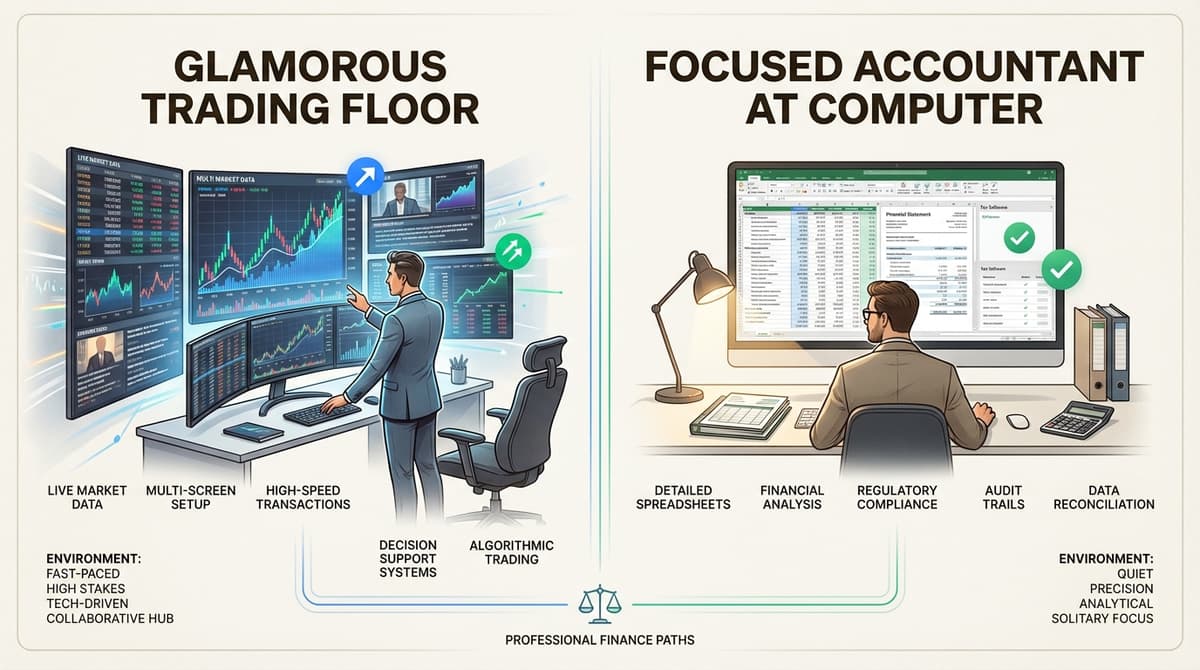
The public sees the glamour; the reality is meticulous number-crunching behind the scenes
The hedge fund industry has cultivated an aura of exclusivity and sophistication. As one academic paper on hedge fund structures notes, they developed “mystique, as clubs that limit access to the rich and famous tend to do.” This perception isn’t accidental. Hedge funds historically catered to ultra-high-net-worth individuals and institutional investors, creating an ecosystem where access itself became a status symbol.
The front office gets all the attention. Portfolio managers appear on CNBC. Traders are profiled in The Wall Street Journal. The Wall Street Prep guide to trading describes how flow traders “make money through a high volume of transactions and charging a bid-offer spread on each transaction.” It’s fast-paced, high-stakes, and visibly exciting.
But here’s the reality: for every dollar a hedge fund manages, there’s a complex web of accounting that must happen behind the scenes. Trades need to be booked. Positions need to be valued. Investor capital needs to be tracked. Regulatory reports need to be filed. And someone has to calculate the Net Asset Value (NAV) that determines how much investors’ shares are worth.
That someone is the fund accountant.
The contrast couldn’t be starker. While portfolio managers are making investment decisions, fund accountants are verifying that those decisions were recorded correctly. While traders are executing strategies, fund accountants are ensuring the cash movements reconcile. The glamour is in the front office. The accuracy, and arguably the fund’s license to operate, depends on the back office.
Fund accounting, also called investment accounting or portfolio accounting, is the specialized practice of tracking and reporting on a pool of investments held in a fund structure. According to Wikipedia’s definition, it “describes the process of accounting for a portfolio of investments such as securities, commodities and/or real estate held in an investment fund such as a mutual fund or hedge fund.”
But what does that actually mean day-to-day?
At its core, fund accounting serves three critical functions:
The Net Asset Value represents the per-share value of the fund. It’s calculated by taking the total value of all fund assets, subtracting liabilities, and dividing by the number of shares outstanding. This sounds straightforward until you realize that hedge funds often hold illiquid securities, complex derivatives, and positions in multiple currencies, all of which need to be valued according to specific methodologies.
When an investor wants to redeem their investment, they need to know what their shares are worth. When a new investor wants to subscribe, they need to know the entry price. Fund accountants produce the statements and reports that make these transactions possible. They also track capital calls and distributions for private funds.
Hedge funds operate under a complex web of regulations. In the US, this includes SEC reporting requirements, Form PF filings for private funds, and various state-level obligations. The ResearchGate paper “Demystifying Hedge Funds” explains how “exceptions from regulation under securities, investment company, investment advisory, and tax laws define hedge fund structures.” Fund accountants ensure the fund stays compliant with these requirements.
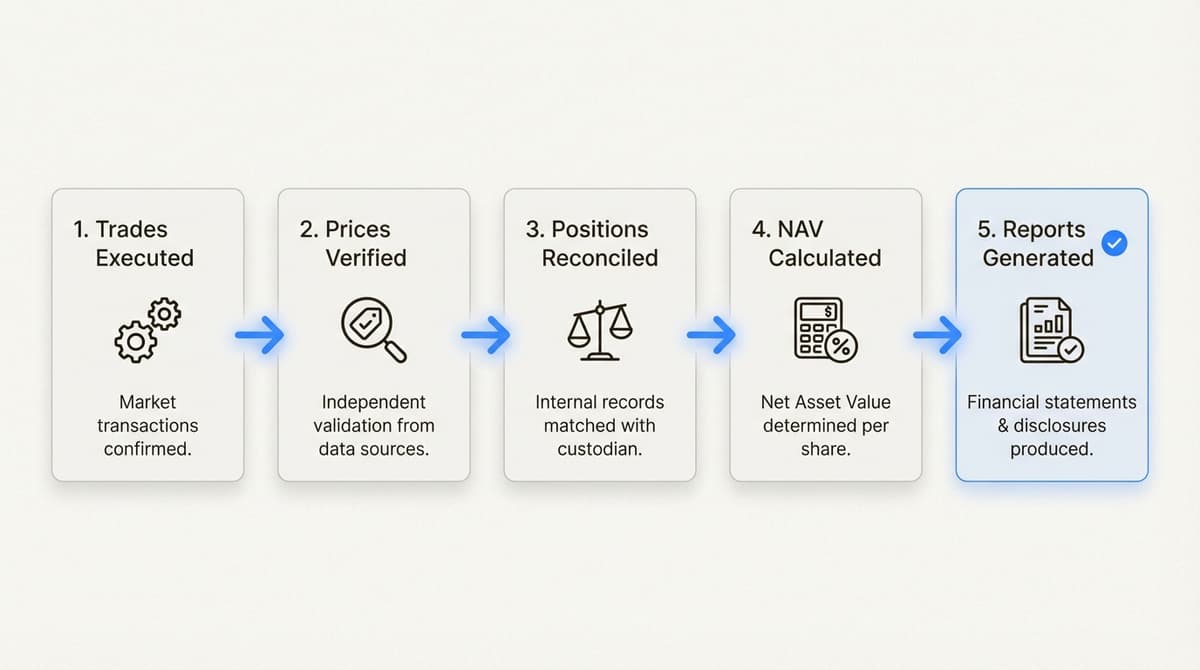
Fund accountants sit at the centre of trade processing, valuation, and investor reporting
Unlike corporate accounting, which focuses on a company’s operations and profitability, fund accounting is investor-centric. The “profit” isn’t the fund’s, it’s the investors’. Every calculation directly impacts how much money someone has made or lost.
If you’re considering fund accounting as a career, you need to understand the daily reality. This isn’t a 9-to-5 job where you clock out and forget about work. It’s a role tied to market cycles, reporting deadlines, and the relentless calendar of financial reporting.
A typical day starts with overnight reconciliation. Trades executed yesterday need to match what the brokers report. Corporate actions, dividends, and interest payments need to be processed. Any discrepancies need to be investigated and resolved.
Midday involves monitoring cash positions, processing new trades, and communicating with portfolio managers about any accounting-related questions. If a PM wants to know the fund’s available cash for a new position, the fund accountant provides that number.
Month-end is when fund accounting gets intense. This is when final NAV calculations happen, financial statements are prepared, and investor reports are generated. Depending on the fund’s structure and investor base, this process can take several days and often requires late nights and weekend work.
The LSEG podcast on women in hedge funds touches on the stress of hedge fund careers. While the discussion focuses on portfolio management, fund accountants experience their own pressure cooker during reporting periods. Miss a NAV deadline, and you’ve got angry investors and potential regulatory issues.
These periods add additional layers of complexity. Auditors get involved. Regulatory filings are due. Tax calculations need to be prepared. Year-end often involves coordinating with multiple service providers, administrators, and legal counsel.
Fund accountants rely on specialized software platforms. Industry-standard systems include:
Bloomberg terminals are also common for verifying prices and researching securities. The technical stack is specialized, and learning these systems is a significant part of the job.
Fund accounting isn’t an entry-level job you stumble into. It requires specific credentials and a particular mindset.
Most fund accountants have a bachelor’s degree in accounting, finance, or a related field. Some roles also prefer or require an MBA, particularly for positions that involve significant interaction with investors or senior management.
For fund accountants, licensing requirements vary by role. If you’re calculating NAVs and preparing financial statements, you may not need any FINRA licenses. If you’re involved in investor communications or advisory functions, the Series 65 becomes relevant.
The technical bar is high. Fund accountants need:
Technical skills get you hired. Soft skills determine whether you succeed:
Most fund accountants come from one of three backgrounds:
Let’s talk money. Fund accounting pays well, though it won’t match the eight-figure compensation of top portfolio managers. What it offers instead is stability and predictable progression.
Compensation varies significantly by location, fund size, and performance. Here’s a general framework:
| Level | Years Experience | Salary Range | Bonus Potential |
|---|---|---|---|
| Staff Accountant | 0-2 years | ₹4 LPA – ₹8 LPA | 10-20% |
| Senior Accountant | 2-5 years | ₹8 LPA – ₹16 LPA | 15-30% |
| Accounting Manager | 5-8 years | ₹16 LPA – ₹30 LPA | 20-40% |
| Controller | 8-12 years | ₹30 LPA – ₹60 LPA | 30-60% |
| CFO | 12+ years | ₹60 LPA – ₹2 Cr+ | 50-100%+ |
The progression is relatively structured:
Fund accounting skills are highly transferable. Common exit paths include:
Compared to front-office roles, fund accounting generally offers better work-life balance, with one major caveat: month-end, quarter-end, and year-end periods are demanding. During these times, 60-70-hour workweeks aren’t uncommon. But outside of reporting periods, the schedule is more predictable than trading or investment banking.
The fund accounting profession is evolving rapidly. Several trends are making this role more complex, and more critical, than ever before.
Post-2008 financial crisis regulations have fundamentally changed how hedge funds operate. The SEC’s Form PF requires detailed reporting on private fund activities. The Alternative Investment Fund Managers Directive (AIFMD) in Europe imposes additional requirements. Fund accountants are on the front lines of compliance.
Traditional stocks and bonds are straightforward to account for. But modern hedge funds trade:
Each of these requires specialized accounting knowledge. The J.P. Morgan demystifying stablecoins article illustrates how even “simple” digital assets require a sophisticated understanding of pegging mechanisms and valuation methodologies.
Institutional investors now expect detailed, frequent reporting. They want to understand not just returns, but risk exposures, liquidity profiles, and fee calculations. Fund accountants produce the data that answers these questions.
Automation is changing the profession. Routine reconciliations are increasingly handled by software. AI is being deployed for data validation and anomaly detection. Blockchain technology promises to streamline settlement and record-keeping.
But this doesn’t mean fund accountants are becoming obsolete. It means their role is shifting from data entry to data analysis, from routine processing to exception handling and judgment calls. The human element, understanding why something doesn’t reconcile and how to properly classify a novel instrument, remains irreplaceable.
Fund accounting isn’t for everyone. Understanding whether you’d thrive in this environment is crucial before pursuing this career path.
Fund accounting offers advantages that aren’t immediately obvious:
If you’re intrigued but unsure, consider:
The hedge fund industry runs on trust. Investors trust that their capital is being managed responsibly. Regulators trust that funds are operating within legal boundaries. And both groups trust that the numbers they’re seeing are accurate.
Fund accountants are the guardians of that trust. They ensure that when a fund reports a 15% return, the number is accurate and backed by proper calculations. They verify that when an investor redeems ₹80 crore or ₹100 crore, the amount paid out is correct as per the fund’s NAV. Lastly, they ensure that when regulators or auditors request data, whether from the Securities and Exchange Board of India (SEBI) or internal compliance teams, the information provided is complete, transparent, and accurate.
It’s not glamorous work. You won’t see fund accountants on CNBC or read about them in Institutional Investor. But without them, the entire edifice of alternative asset management would collapse.
For the right person, fund accounting offers a challenging, well-compensated career with genuine impact. The work is complex, the stakes are high, and the demand for skilled professionals continues to grow. If you’re drawn to finance but prefer precision over speculation, process over chaos, and steady progression over boom-or-bust outcomes, fund accounting deserves serious consideration.
The glamour may be in the front office. But the foundation is in fund accounting.
Also read: Is a Relationship Manager just sales? The truth about corporate banking RMs
A1: Fund accounting in a hedge fund involves tracking and reporting on the fund’s portfolio of investments. This includes calculating Net Asset Value (NAV), reconciling trades, processing corporate actions, preparing financial statements, and ensuring regulatory compliance. Fund accountants serve as the operational backbone that enables portfolio managers to focus on investment decisions.
A2: While corporate accounting focuses on a company’s operations and profitability, fund accounting is investor-centric. Every calculation directly impacts investor capital. Fund accounting also deals with unique complexities like daily NAV calculations, complex derivatives valuation, multi-currency portfolios, and specialized regulatory requirements that don’t exist in corporate accounting.
A3: Most fund accounting positions don’t require FINRA licenses like the Series 7. However, the Series 65 license may be required if your role involves investment advisory functions. Specific requirements vary by firm and role responsibilities.

CA MONK Team
CA Career & Learning Platform
CA MONK Team is the team behind CA Monk, India's CA career and learning platform. We help Chartered Accountants and CA aspirants build skills, explore career opportunities, connect with mentors, and navigate their professional journey through courses, mentorship, career tools, placements, and practical industry insights.
