
Article Topics
Landing an interview with a top-tier firm like Deloitte or EY is a significant achievement. Before demonstrating your skills, you must first pass the pre-employment screening, which often includes the Pearson Versant test.
It is common to feel apprehensive about an AI evaluating your communication skills. The Versant test is an AI-powered assessment designed to test English proficiency quickly and efficiently. However, success on this test does not require an extensive vocabulary; it focuses on a more fundamental aspect of communication.
This guide explains the Versant test in detail, covering how the AI grades you, the complete test format, and a clear plan for effective Versant test practice.
Understanding the Pearson Versant test
The Versant test is an automated English proficiency exam from Pearson, and it is widely used in the corporate world. Companies like Amazon, Deloitte, and Accenture use it to screen candidates because it is fast, reliable, and removes human bias from the initial review.
The entire test usually takes about 17 minutes to complete, and you get your results almost instantly. What makes it so popular with recruiters is its convenience and its unique way of scoring.
Here’s a quick rundown of what makes the Versant test different:
- It’s scored by AI: Instead of a human listener, the test uses advanced speech recognition and AI to give an objective, unbiased assessment of your real-world communication skills. It is all about the data.
- It’s fast and convenient: You can take it 24/7 from home on your computer or even a smartphone. There is no need to book a slot at a testing centre or travel anywhere. You just need a quiet room and a stable internet connection.
- It focuses on practical communication: This is not a high school English final. The test measures your “facility in spoken English,” which means it checks if you can understand and respond naturally, like you would in a real conversation. It is less about academic knowledge and more about practical, everyday communication.
How the Versant AI scoring model works
Understanding how the Versant AI functions provides a significant advantage. Many people assume they need to use complex words and perfectly crafted sentences to impress the machine. This is a common misconception.
Programmers designed the AI to value one thing above all else: automaticity. It wants to see if you can speak English naturally and spontaneously, without overthinking it.
Content vs. manner in scoring
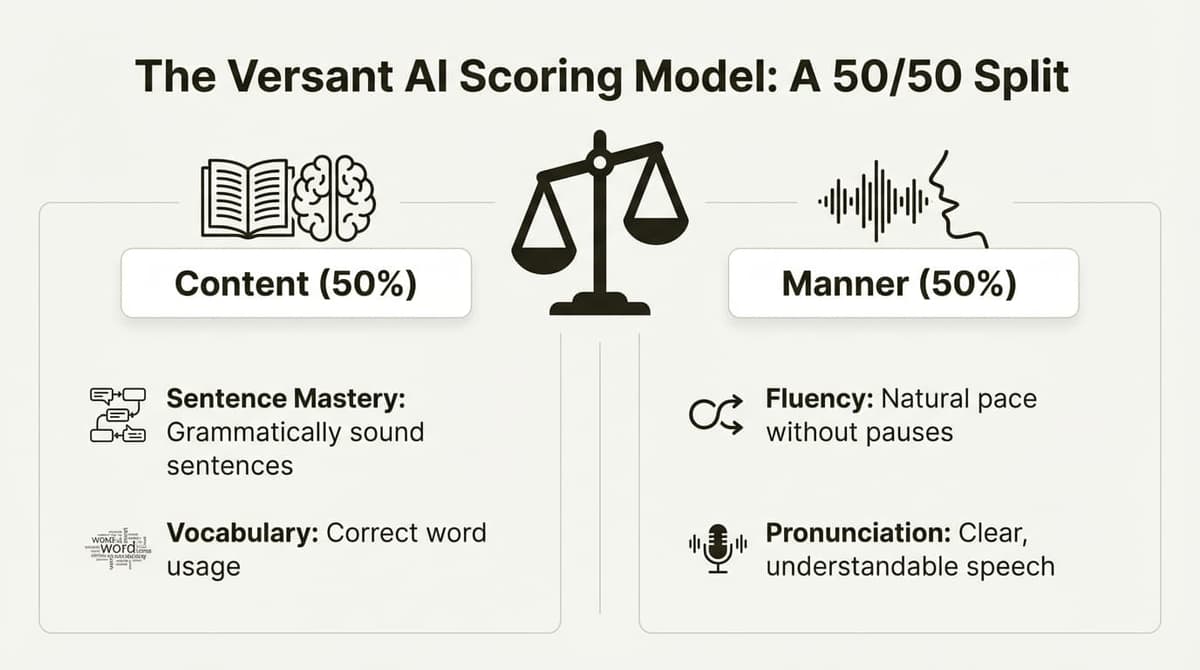
Your final score is a blend of what you say and how you say it, with each part having equal importance. Think of it as a 50/50 split.
- Content (50%): This is the accuracy of your words. The AI checks this through two subscores: Sentence Mastery (are your sentences grammatically sound?) and Vocabulary (are you using the right words?).
- Manner (50%): This is the quality of your speech. This is measured by your Fluency (do you speak at a natural pace without awkward pauses?) and Pronunciation (can the AI clearly understand your words?).
Pausing for a few seconds to think of a more advanced word can actually hurt you. Why? Because that pause negatively impacts your Fluency score. The AI would rather hear you say, “The cat is on the mat” smoothly than hear you stumble while trying to say, “The feline is situated upon the floor covering.” The key is to speak simply but continuously.
How the AI evaluates language capabilities
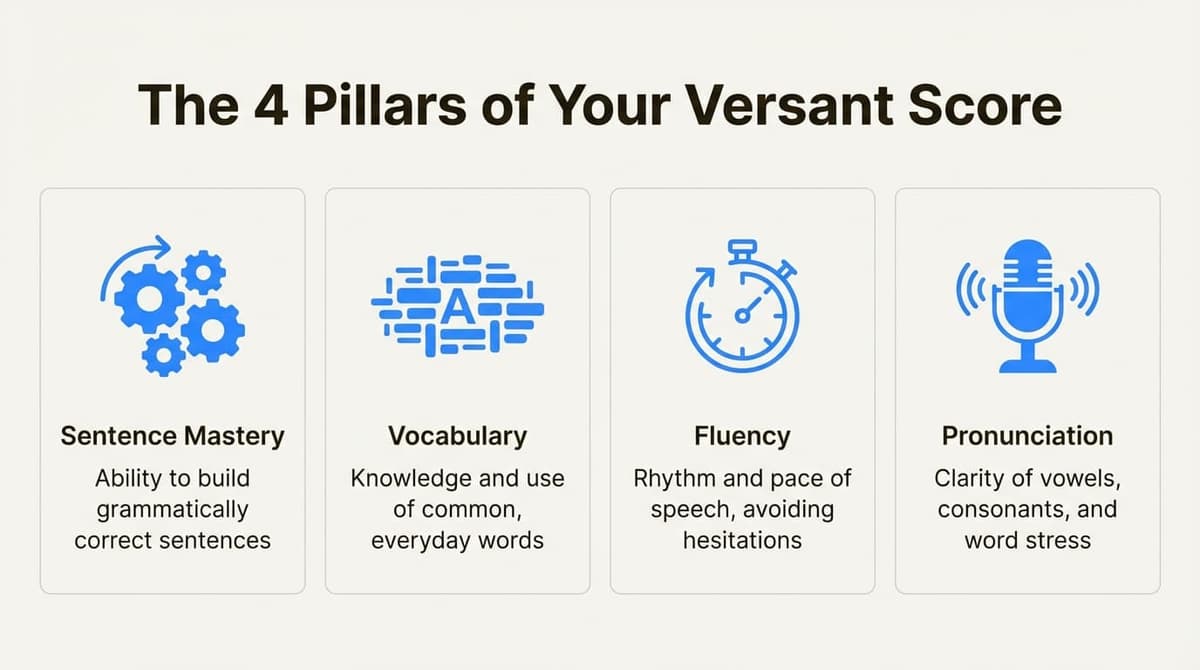
Your overall score is calculated from four smaller diagnostic scores. Knowing what they are helps you focus your Versant test practice on the right things. According to the official score reports, here’s what the AI is listening for:
- Sentence Mastery: This measures your ability to build grammatically correct sentences on the fly. The AI is checking if you understand and use English sentence structures correctly.
- Vocabulary: This one is pretty straightforward. It tests if you know and can use common, everyday words in the right context. You do not need a massive vocabulary, just a functional one.
- Fluency: This is all about rhythm and pace. The AI analyzes how smoothly and quickly you form sentences. Long hesitations, false starts, and unnatural pauses will lower this score.
- Pronunciation: This measures how clearly you speak. The AI checks your vowels, consonants, and word stress to see if a native speaker could easily understand you.
Focusing on improving your Fluency and Pronunciation can often give you the biggest score boost because it is half of your total grade.
The Versant English test format
The test can seem very fast because it moves so quickly. In 17 minutes, there are about 63 questions to answer. Knowing what to expect for each section will keep you from getting flustered on test day.
The official test guide breaks the test into six parts. Here’s a detailed look at each one, along with a key tip to help you score high.
| Part | Test Section | Task | Items | Key Tip |
|---|---|---|---|---|
| A | Reading | Read sentences aloud as instructed. | 8 | Focus on clear pronunciation and natural pauses based on punctuation to maximize your Pronunciation and Fluency scores. |
| B | Sentence Repeats | Repeat sentences you hear verbatim. | 16 | Listen carefully and repeat exactly what you hear. The AI is testing your recall and ability to form correct sentences (Sentence Mastery). |
| C | Short Answer Questions | Answer simple questions with a word or short phrase. | 24 | Be quick and concise. The goal is to test your Vocabulary and comprehension, not detailed explanations. |
| D | Sentence Builds | Rearrange three word groups to form a correct sentence. | 10 | Form the sentence in your head first, then say it smoothly. Correcting yourself mid-sentence can hurt your Fluency score. |
| E | Story Retelling | Retell a short story in your own words. | 3 | Focus on the main points (who, what, when, where). Aim for 30 seconds of continuous speech to showcase Fluency and Sentence Mastery. |
| F | Open Questions | Answer two opinion-based questions. | 2 | Speak for the full 40 seconds. Although this part is not scored, it may be reviewed by recruiters. |
The main takeaway here is that every section is designed to test one or more of the four core skills. For example, the Reading section is a direct test of your Pronunciation and Fluency, while Sentence Builds is a great measure of your Sentence Mastery.
Creating your practice plan
You should not take the Versant test without practice. However, not all practice is equally effective. You need a smart plan that targets the AI’s scoring criteria and gets you comfortable with the test’s pace.
The importance of official practice materials
The best way to prepare is to simulate the real test environment as closely as possible. The official practice tests from Pearson were made by the same people who designed the actual exam, so they are the most accurate simulation you can get.
For $15, you get a full-length practice test that gives you a detailed score report. This report breaks down your performance across all four subskills (Sentence Mastery, Vocabulary, Fluency, and Pronunciation), so you can see exactly where you need to improve. It takes the guesswork out of your preparation.
A step-by-step practice guide
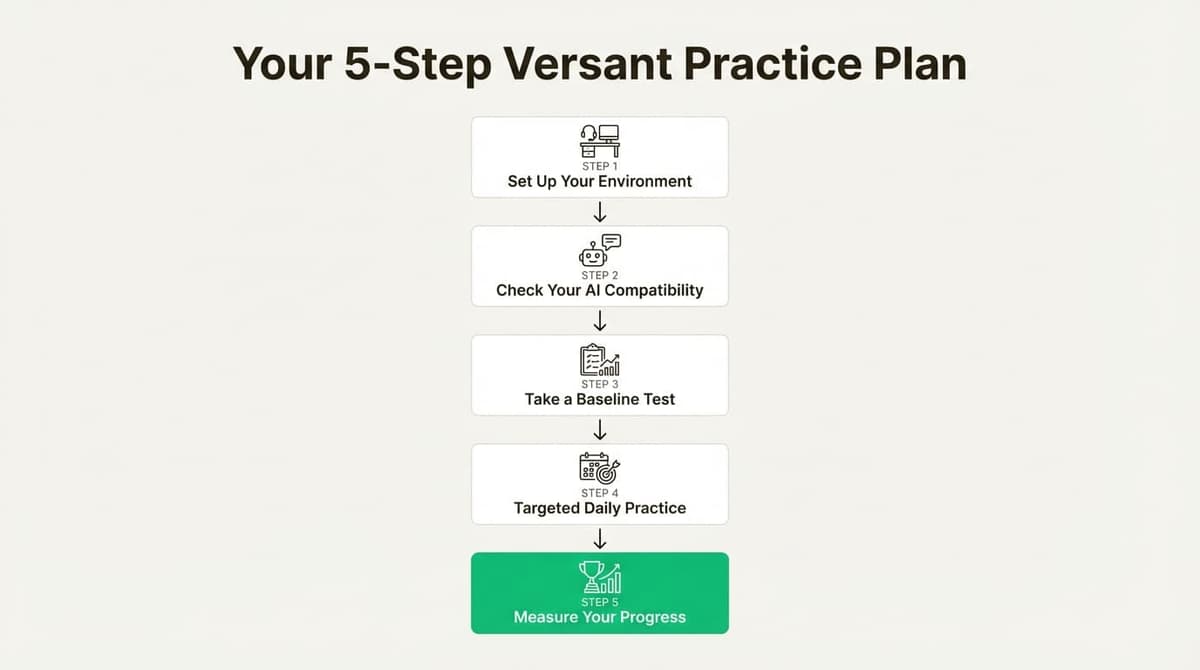
Here is a simple, effective framework to build a solid study plan.
- Set Up Your Environment: First, get your tech sorted. Find a quiet room where you will not be interrupted. The real test requires a headset with a microphone, so use one for all your practice sessions to get used to it.
- Check Your AI Compatibility: Before spending any money, it is a good idea to do a low-stakes practice round to see how your speaking style meshes with an AI grader and to experience the question format without any pressure. Think of it as a warm-up.
- Take a Baseline Test: Once you are comfortable, take an Official Versant Practice Test. This will give you an accurate starting score and a diagnostic report. This report is your roadmap; it tells you exactly which areas to focus on.
- Targeted Daily Practice: Do not cram. Instead, dedicate 15-20 minutes every day to working on your weak spots.
- For Fluency: Grab your phone, open a news article, and record yourself summarizing it for 60 seconds. Listen back and see where you paused or stumbled.
- For Pronunciation: Use a pronunciation app to practice specific vowel and consonant sounds that the report flagged as tricky for you.
- For Sentence Mastery: Practice the “Sentence Builds” section. You can easily create your own by writing a sentence, cutting it into three parts, and scrambling them.
- Measure Your Progress: About a week before your real test, take one last practice test. This will show you how much you’ve improved, boost your confidence, and get you mentally prepared for the real thing.
Common mistakes to avoid
Even with practice, it is easy to fall into a few common traps. Keep these in mind during your prep and on test day.
- Speaking too quickly or slowly: The AI is looking for a natural, conversational pace. Rushing can make you sound unclear, while speaking too slowly can hurt your Fluency score. Try to find a comfortable, steady rhythm.
- Leaving long pauses: Silence can lower your score. If you get stuck on a question, it is better to say something simple and relevant than to say nothing at all. Even a phrase like “Let me think about that for a moment” is better than dead air.
- Correcting yourself: In a normal conversation, correcting yourself is fine. But in the Versant test, the AI might flag it as a break in fluency. If you make a small mistake, it is often better to just keep going and finish the sentence.
- Ignoring punctuation: In the Reading section, punctuation marks are useful cues. Use commas and periods to pause briefly. This shows the AI that you understand sentence structure and improves both your Fluency and Pronunciation scores.
Understanding Versant test costs
Preparing for the Versant test does not have to be expensive.
An official Versant practice test costs $15, which is a small price for a detailed diagnostic report and a realistic test experience.
As for the actual test, the fee usually ranges from $15 to $40, but in most cases, the company you are applying to will cover this cost. They will typically send you a link with a Test Identification Number (TIN) to take the exam. When you look at it as an investment in landing a competitive role at a top company, it is one of the best-return investments you can make in your career.
Your path to a successful score
Cracking the Versant test is not about being a perfect English speaker. It is about understanding the test and playing by the AI’s rules. Key takeaways include:
- Fluency over complexity: The AI rewards smooth, continuous speech. Speak simply and at a natural pace rather than pausing to find impressive words.
- Know the format: Get familiar with the six parts of the test. Knowing what is coming next eliminates surprises and helps you stay calm and focused.
- Practice smart: Use AI-aligned tools and official materials. A solid Versant test practice plan turns anxiety into confidence.
This test is just one small step on your career journey. With the right strategy and a bit of preparation, you can approach it confidently.
Also read: Ace Your Interview With These Equity Research Interview Questions for CAs
