🎯Ace your interviews with GIR Workshop with this is a test text I will make it big in length to test the marquee
🎯Ace your interviews with GIR Workshop with this is a test text I will make it big in length to test the marquee
Article Topics
After passing your exams and starting an articleship, you may find the reality of the work is different from your expectations. Many articles find their daily tasks are heavy on data entry and repetitive compliance forms, leading to a feeling that their learning curve has flatlined. If this situation feels familiar, you are not alone.
This often leads to the question of whether to take a transfer, followed by the concern of whether it will negatively impact your career. It is common to worry that a transfer on your resume suggests an inability to adapt or a lack of commitment.
However, a transfer is not necessarily a negative mark on your career. It can be a necessary course correction. When handled professionally, it can signal ambition. A successful transfer depends on understanding the rules, managing your exit professionally, and communicating the move as a strategic career decision. This guide will walk you through the official ICAI rules for Form 109, the unwritten rules of leaving a firm, and how to tell a compelling story in your next interview.
Before proceeding with a transfer, it is essential to understand the governing regulations. The Institute of Chartered Accountants of India (ICAI) has specific guidelines for transfers, and the rules vary depending on your articleship year.
In the first year, the process is straightforward. The key element is "mutual consent."
According to the latest ICAI FAQs, you can transfer in your first year provided both you and your principal agree. You do not need a detailed reason or prior approval from the ICAI. If your principal agrees, a simple self-declaration confirming this agreement is sufficient for your Form 109.
After the first year, the rules for transferring become more stringent. "Mutual consent" alone is no longer sufficient. To get a transfer approved, your reason must align with one of the specific categories recognized by the ICAI.
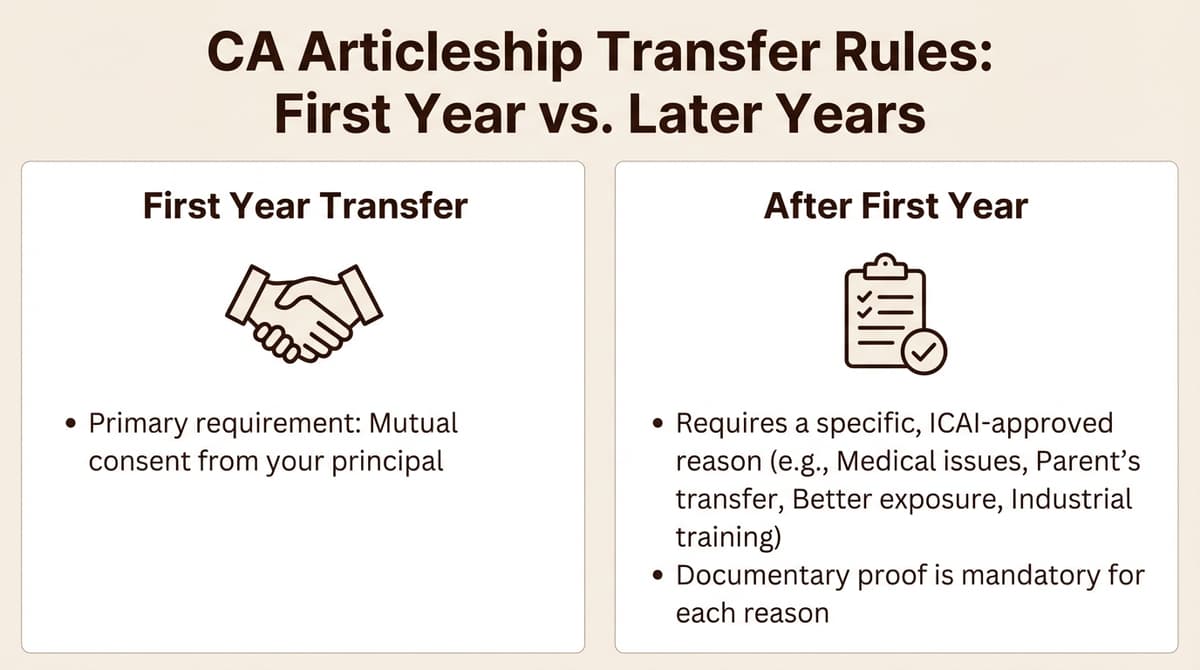
Organizing your documents is essential, as you must provide proof to support your reason. Here is a summary of the approved reasons and the required paperwork for your application:
| Permitted Ground | Required Documents |
|---|---|
| Medical Issues (Student) | Application signed by student & principal + Medical reports from a registered practitioner. |
| Parent's Medical Issues | Application signed by student & principal + Parent's medical reports from a registered practitioner. |
| Family/Parent Transfer (to a city >50km away) | Application signed by student & principal + Certified copy of the parent's transfer order. |
| Marriage (if relocating to a city >50km away) | Application signed by student & principal + Marriage invitation card. |
| Better Exposure | Application written by the student explaining the learning gap, and it must be signed by the principal. |
| Joining Industrial Training | Application signed by student & principal + Offer letter from the company for industrial training. |
| Principal Related (Death, surrender of COP, etc.) | Form 109 signed by student & principal. For death of principal, use Form 110 (sole proprietor) or Form 111 (partner). |
The entire transfer process is managed online through the ICAI's Self-Service Portal (SSP). You will fill out Form 109, have it signed by your current and future principals, and upload it with your supporting documents.
Additionally, for all students who began their training after January 1, 2026, maintaining an E-Diary is a requirement. As announced by the ICAI, this is a digital log for tracking your daily work, which requires your principal's approval every two weeks. A complete and approved E-Diary is a key part of your training record. If you are requesting a transfer for "better exposure," a detailed diary can serve as evidence to support your claim.
Ideally, your principal will consent to the transfer. However, if they refuse to sign the forms, this can be a challenging situation, but there are alternative steps.
If you cannot obtain your principal's signature, you can file Form 120 directly with the ICAI. The official FAQs confirm this is a valid procedure. However, this should be considered a last resort. Filing Form 120 makes the process more formal, as the ICAI will begin sending reminders to your principal. Attempting to leave on amicable terms is always the recommended first step.
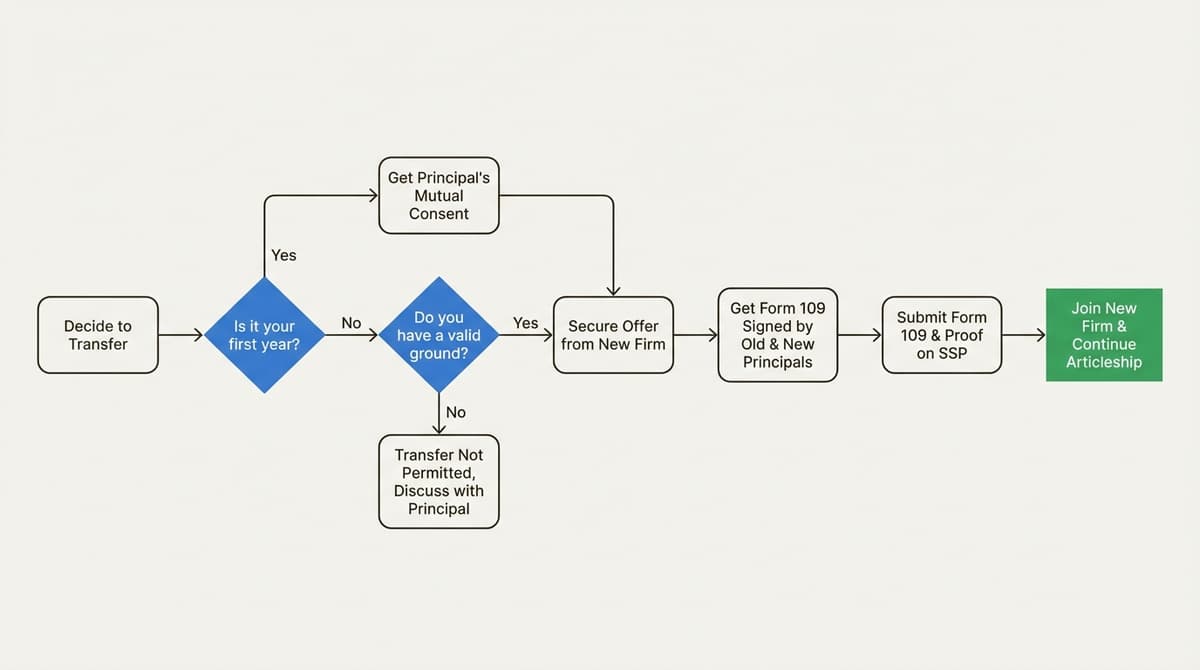
Once the paperwork is complete, the next step is preparing for interviews at new firms. The key is not the transfer itself, but how you explain it. A clear explanation can frame you as a strategic professional, while an unclear one might be perceived negatively.
Reframe the narrative. You are not leaving a negative situation, but proactively moving toward an opportunity that better aligns with your career goals. This mindset shift changes the focus from desperation to ambition.
Avoid speaking negatively about your previous firm, principal, or colleagues. This is generally considered unprofessional and can be a concern for interviewers. The goal is to frame your reason for leaving around the appeal of the new opportunity, not any dissatisfaction with your previous job.
Keep the focus on skills, experience, and growth. Discuss what you learned in your last role and how you aim to build upon it. Here's a quick guide:
| Don't Say This | Say This Instead | Why It Works |
|---|---|---|
| "My boss was terrible and I learned nothing." | "My previous firm gave me a strong foundation in direct tax compliance. I am now actively seeking a role with more exposure to statutory audit, which I know is a core strength of your firm." | It shows ambition and compliments the new firm, framing the move around professional growth, not negativity. |
| "The work was boring and repetitive." | "After spending a year focused on ROC filings, I'm eager to apply that foundational knowledge to more complex engagements like internal financial controls and risk advisory." | It re-frames "boring work" as "foundational experience" and signals a desire for more challenging responsibilities. |
| "I need a better stipend." | "While compensation is a factor, my primary motivation is the opportunity to work with a more diverse client base and gain experience in the manufacturing sector, which I am very passionate about." | It acknowledges financial reality but subordinates it to professional goals and interests relevant to the new firm. |
An interviewer might ask a direct question like, "So, what didn't you like about your last firm?"
Acknowledge the question and steer the conversation back to your forward-looking narrative. A solid response could be: "It wasn't about disliking my previous firm at all. They gave me a great start. It was more about recognizing that to achieve my long-term goal of specializing in forensic audit, I needed to join a firm with a dedicated practice in that area, which is why I'm so excited about this opportunity."
After completing a transfer, it is important to ensure the new firm is a better long-term fit. Avoid accepting the first available offer without due diligence.
Clarify what you need in your next role. What was missing from your last firm that is a requirement for the next one? Consider your main goals:
A firm's reputation is only one factor to consider. Your daily experience will depend on your team and your work. Conduct thorough research. Look up the firm on LinkedIn, and consider reaching out to current or former articles to get their perspective.
In the interview, come prepared with insightful questions. This demonstrates your seriousness and helps you determine if the firm is the right fit. Here are a few ideas:
Switching firms during your articleship can seem like a significant risk, but it does not have to negatively impact your career. When handled correctly, it can be a powerful turning point and a moment of taking active control over your professional development.
A successful transfer depends on three things: knowing and following the ICAI rules, leaving with professionalism, and telling a story about future growth rather than past problems. The focus should be on moving toward a better opportunity, not just leaving a previous situation. By being strategic, you can ensure your next move is a step up on your CA journey.
A1: In the first year, the process is based on "mutual consent." As long as you and your principal agree to the transfer, you can proceed by submitting Form 109 with a self-declaration. You don't need to provide any other specific reason to the ICAI.
A2: While it's always best to get your principal's consent, they can't completely block you. If they refuse to sign Form 109, you can file Form 120 directly with the ICAI as a last resort. The ICAI will then mediate the process.
A3: After the first year, you need a valid reason approved by the ICAI. These include medical issues (for you or a parent), family relocation, marriage, joining industrial training, or seeking better exposure (which requires your principal's sign-off on the learning gap).
A4: Frame it as a strategic career move, not an escape from a bad firm. Focus on what you want to learn and the specific opportunities the new firm offers. For example, mention wanting exposure to a new industry or a different type of audit that your old firm didn't provide. Never speak negatively about your previous employer.
A5: Not at all, if handled professionally. A well-managed transfer shows ambition and a proactive approach to your career development. The key is to follow the ICAI rules, leave on good terms, and have a clear, positive story for your next interview.
A6: Form 109 is the official ICAI application for transferring your articleship from one firm to another. It must be filled out on the Self-Service Portal (SSP) and signed by both your old and new principals. It's the central document that makes your transfer official.

CA MONK Team
CA Career & Learning Platform
CA MONK Team is the team behind CA Monk, India's CA career and learning platform. We help Chartered Accountants and CA aspirants build skills, explore career opportunities, connect with mentors, and navigate their professional journey through courses, mentorship, career tools, placements, and practical industry insights.
